Elbow Sleeves for Bench Press | Powerlifting & Strongman Guide

What Do Elbow Sleeves Do? A Guide for Bench Press, Overhead Press and Strongman
Elbow sleeves are commonly used by powerlifters, strongman athletes, bodybuilders and general gym lifters during pressing movements.
They are worn around the elbow to provide compression, retain warmth and create a firmer feel during training. Depending on their material, thickness and construction, some sleeves feel relatively flexible, while others are much stiffer and more restrictive.
The right elbow sleeve is not necessarily the thickest or most aggressive option available. It is the sleeve that suits the way you train, the amount of pressing volume you perform and the level of compression you prefer.
This guide explains what elbow sleeves do, when they may be useful and how to choose between different styles.
What Are Elbow Sleeves?
Elbow sleeves are fitted pieces of strength equipment worn over the elbow joint.
Most are made from neoprene, elastic fabric or layered materials designed to fit closely around the arm. They are generally sold as a pair and are used during exercises such as:
Bench press
• Overhead press
• Push press
• Log press
• Axle press
• Dumbbell press
• Close-grip bench press
• Triceps-focused pressing
• Strongman pressing events
Unlike elbow wraps, sleeves are pulled onto the arm rather than wound around it.
Unlike wrist wraps, they sit around the elbow rather than the wrist.
Unlike bench press aids, elbow sleeves are primarily used for warmth, compression and training feel rather than providing a large amount of assistance through the movement.
What Do Elbow Sleeves Actually Do?
Elbow sleeves are mainly used for three reasons:
• Retaining warmth around the elbow
• Applying compression
• Creating a firmer and more consistent feel during pressing
The exact effect depends on the sleeve.
A thinner or more flexible sleeve may provide light compression while remaining comfortable across a long session. A thicker or stiffer sleeve may create a much tighter and more restrictive feel.
Elbow sleeves should not be treated as a replacement for good technique, sensible programming or appropriate load selection. They are an accessory that may make certain training sessions feel more comfortable and consistent.
Elbow Warmth During Training
One of the most noticeable effects of elbow sleeves is warmth.
Because the sleeve covers the elbow and surrounding area, it can help retain heat during training. This may be especially useful during:
• Early-morning gym sessions
• Winter training
• Strongman competitions held outdoors
• Long bench press sessions
• Training days with extended rest periods
• High-volume pressing workouts
Many lifters put their elbow sleeves on during their warm-up sets and leave them on throughout the main pressing work.
This can help the elbows feel consistently warm between sets, particularly when the gym is cold or the session runs for an extended period.
Elbow sleeves should still be used alongside an appropriate warm-up. Wearing sleeves does not replace gradually increasing the load and preparing for the movement being performed.
Compression Around the Elbow
Elbow sleeves apply pressure around the elbow and surrounding tissues.
The amount of compression varies depending on:
• Sleeve thickness
• Material
• Number of layers
• Stiffness
• Sleeve shape
• Sizing
• The lifter’s arm measurements
A comfortable training sleeve may provide moderate compression without significantly restricting elbow movement.
A stiff or competition-style sleeve may feel much tighter and can require more effort to put on and remove.
Some lifters prefer a strong level of compression during heavy pressing, while others find aggressive sleeves uncomfortable during longer sessions.
The right amount of compression is a matter of training use and personal preference.
A Firmer Feel During Pressing
Elbow sleeves can create a more contained or secure feeling as the elbow bends and straightens.
This is one of the main reasons lifters use them during bench press and overhead work.
A sleeve that fits correctly may feel consistent from the warm-up sets through to the main work. This can make the equipment feel like a natural part of the session rather than a distraction.
However, a sleeve that is too tight, too stiff or poorly shaped may bunch behind the elbow, slide out of position or become uncomfortable after several sets.
The best sleeve is one that provides the desired level of compression without interfering with the movement.
Do Elbow Sleeves Increase Pressing Strength?
Elbow sleeves should not be described as directly building strength.
Pressing strength develops through:
• Consistent training
• Progressive loading
• Appropriate programming
• Good exercise technique
• Recovery
• Nutrition
• Repeated exposure to the movement
Some thick or stiff sleeves may provide a small amount of assistance as the elbow bends and the material stretches.
How noticeable this feels will depend on:
• Sleeve construction
• Sleeve tightness
• Exercise selection
• Range of motion
• The individual lifter
This effect is generally different from a dedicated bench press aid or compression band, which is specifically designed to assist the pressing movement.
Elbow sleeves are primarily used for warmth, compression and a firmer training feel.
Elbow Sleeves for Bench Press
Bench press is one of the most common exercises for elbow sleeve use.
A bench press session may include several warm-up sets, multiple working sets and additional pressing exercises. Elbow sleeves may help retain warmth and provide a consistent level of compression throughout the session.
They are commonly worn during:
• Competition-style bench press
• Paused bench press
• Close-grip bench press
• Incline bench press
• Dumbbell bench press
• Board press
• Pin press
• Repetition bench work
Elbow sleeves may be particularly appealing to lifters who complete a high amount of bench press volume each week.
They can also be useful during long sessions where the elbows would otherwise cool down between working sets.
Elbow sleeves cannot correct poor bar path, an inconsistent touch point or an unstable setup. These issues must be addressed through coaching, practice and appropriate programming.
Elbow Sleeves for Overhead Press
Elbow sleeves are also commonly used during overhead pressing.
This includes:
• Strict press
• Push press
• Military press
• Dumbbell shoulder press
• Log press
• Axle press
• Viking press
• Circus dumbbell
• Seated overhead press
Overhead pressing often places the elbows through repeated flexion and extension under load.
A well-fitted sleeve may provide warmth and compression across the full session without requiring constant adjustment.
For volume-based overhead training, a more flexible sleeve may be easier to wear across several exercises.
For heavy singles or lower-repetition pressing, some lifters may prefer a stiffer sleeve.
Elbow Sleeves for Strongman
Strongman athletes regularly perform several different pressing movements.
Depending on the event or training block, this may include:
• Log press
• Axle press
• Viking press
• Circus dumbbell
• Block press
• Repetition overhead events
• Clean and press variations
Strongman sessions can also be long, particularly when several events are trained on the same day.
Elbow sleeves are practical because they can be worn across multiple pressing movements without needing to be rewrapped before every set.
A strongman athlete may prefer a sleeve that provides firm compression while still allowing enough movement for cleaning implements into position.
The most aggressive sleeve is not always the most practical option. A sleeve that works for one heavy press may feel too restrictive across an entire event session.
Elbow Sleeves for General Gym Training
Elbow sleeves are not limited to competitive powerlifters or strongman athletes.
They may also suit gym lifters who regularly perform:
• Bench press
• Dumbbell pressing
• Shoulder press
• Machine pressing
• Dips
• Triceps work
• Upper-body strength training
For general training, comfort is often more important than maximum stiffness.
A sleeve that can be worn across several exercises may provide more value than a highly restrictive model designed mainly for selected heavy sets.
Lifters should choose according to the training they perform most often rather than the heaviest set they might attempt occasionally.
One of the main decisions when choosing elbow sleeves is whether to select a softer training sleeve or a stiffer, more aggressive model.
Softer elbow sleeves generally provide:
• Greater flexibility
• Easier movement
• More comfort during longer sessions
• Easier application and removal
• Moderate compression
• Better suitability for repeated sets
They may suit:
• General gym training
• High-volume pressing
• Bodybuilding sessions
• Longer bench workouts
• Lifters new to elbow sleeves
• Athletes who prioritise comfort
Stiffer sleeves generally provide:
• Firmer compression
• A more restrictive fit
• A more substantial feel
• Less flexibility
• Greater difficulty when putting them on
• Better suitability for selected heavy sets
They may suit:
• Heavy bench press
• Heavy overhead pressing
• Strongman pressing
• Lower-repetition work
• Experienced lifters who prefer aggressive compression
Neither style is automatically better.
A softer sleeve may be the better choice for a lifter completing several pressing exercises in one session. A stiff sleeve may be more suitable for someone who wants a firm fit during heavy work.
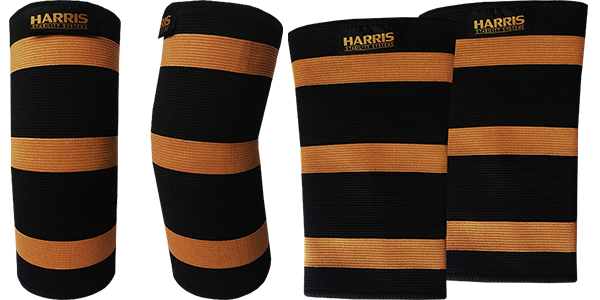
Two-ply elbow sleeves use more than one layer of material.
This generally creates a thicker and more substantial sleeve than a basic single-layer design.
Two-ply sleeves may appeal to lifters who want:
• Greater compression
• A firmer fit
• More substantial material
• A sleeve suited to heavy pressing
• A balance between flexibility and stiffness
The exact feel will depend on the materials, construction and sizing of the individual sleeve.
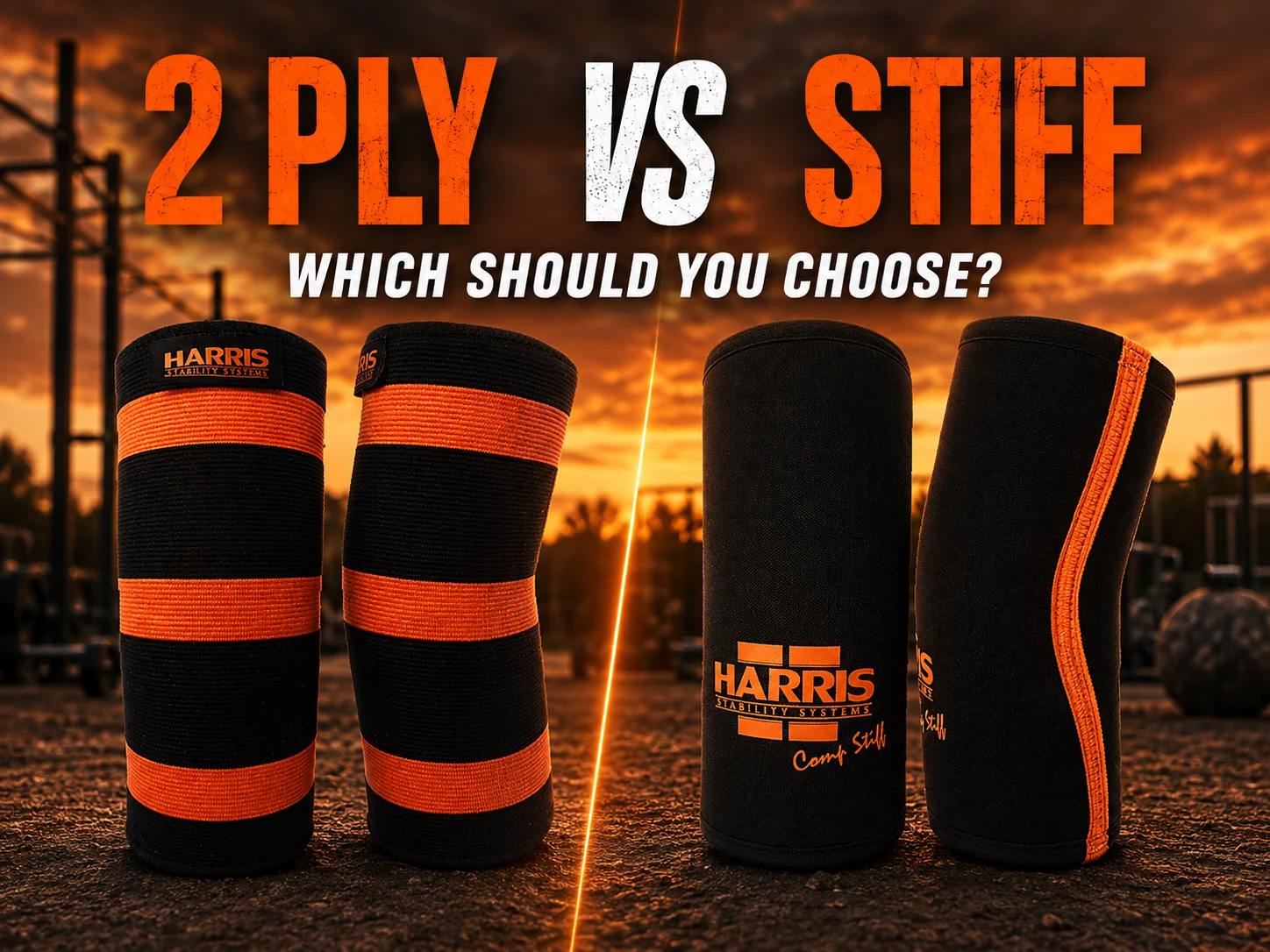
The Harris 2Ply Elbow Sleeves may suit lifters who want a firm pressing sleeve without moving directly to the stiffest option in the range.
They may be suitable for:
• Bench press
• Overhead press
• Strongman pressing
• Heavy triceps work
• Repeated working sets
Two-ply construction does not automatically mean that the sleeve will feel extremely stiff. The final fit still depends on the shape, materials and chosen size.
Competition-Stiff Elbow Sleeves
Competition-stiff elbow sleeves are designed for lifters who prefer a more aggressive fit.
The Harris Comp Stiff Elbow Sleeves 9mm are positioned towards the firmer end of the range.
A 9mm sleeve may feel:
• Thicker
• More restrictive
• Harder to put on
• Less comfortable across long sessions
• Better suited to selected heavy pressing sets
This type of sleeve may appeal to experienced powerlifters or strongman athletes who already know that they prefer strong compression.
A competition-stiff sleeve may not be the best choice for every session.
For example, it may feel suitable during heavy bench press or log press but unnecessarily restrictive during high-repetition dumbbell work or bodybuilding-style training.
The word “competition” in a product name does not guarantee approval in every federation or event. Equipment rules should always be checked before competing.
2-Ply vs Stiff Elbow Sleeves
The choice between two-ply and stiff elbow sleeves depends on how the sleeves will be used.
|
Feature |
||
|---|---|---|
|
Compression |
Firm |
Very firm |
|
Flexibility |
Moderate |
Lower |
|
Comfort |
Better for repeated work |
Better suited to selected heavy sets |
|
Ease of putting on |
Moderate |
More difficult |
|
Training use |
General heavy pressing |
Heavy or specialised pressing |
|
Session length |
Suitable for longer use |
May be better for shorter periods |
|
Best suited to |
Lifters wanting balance |
Lifters wanting maximum stiffness |
A lifter who performs several pressing exercises and wants to keep the sleeves on for most of the session may prefer the two-ply option.
A lifter who wants the firmest fit for heavy bench press or strongman pressing may prefer the competition-stiff option.
The better sleeve is the one that suits the majority of the lifter’s training.
How Tight Should Elbow Sleeves Be?
Elbow sleeves should feel firm and secure without causing unnecessary pain, numbness or loss of movement.
A correctly fitted sleeve should generally allow you to:
• Bend and straighten the elbow
• Maintain normal feeling in the hands and fingers
• Grip the bar or implement normally
• Complete the intended movement
• Keep the sleeve in position
• Remove the sleeve after training
Stiff sleeves may naturally feel tighter than flexible training sleeves.
However, deliberately buying a sleeve that is far too small can make it difficult to position, uncomfortable to wear and impractical for repeated training.
A tighter fit does not automatically mean a better sleeve.
Signs Elbow Sleeves May Be Too Tight
A sleeve may be too tight if it causes:
• Numbness
• Tingling
• Significant loss of movement
• Severe discomfort
• Hand discolouration
• Difficulty gripping
• Excessive pinching behind the elbow
• Inability to position the sleeve correctly
If the sleeve cannot be worn safely or comfortably for the intended exercise, a different size or model may be more appropriate.
Signs Elbow Sleeves May Be Too Loose
A sleeve may be too loose if it:
Slides down during sets
• Rotates around the arm
• Bunches behind the elbow
• Provides very little compression
• Requires constant adjustment
• Does not remain centred over the elbow
A sleeve should sit firmly enough to remain in position throughout the movement.
How to Measure for Elbow Sleeves
Elbow sleeve sizing methods can differ between brands and products.
A sizing guide may ask for a measurement:
• Around the elbow
• Above the elbow
• Below the elbow
• With the arm straight
• With the arm slightly bent
Always use the measurement method shown on the product-specific sizing chart.
Do not assume that:
• Knee sleeve sizing will apply to elbow sleeves
• Another brand’s size will be the same
• Your clothing size will determine sleeve size
• The same size will suit every sleeve model
A stiff sleeve and a flexible sleeve may fit differently even when they use similar size labels.
How to Put Elbow Sleeves On
The exact method depends on the sleeve’s length, thickness and stiffness.
A general process is:
1. Check that the sleeve is the correct way up.
2. Gather or fold the sleeve if required.
3. Slide it over the hand and forearm.
4. Pull it towards the elbow.
5. Position the centre of the sleeve over the elbow joint.
6. Smooth out major folds or bunching.
7. Check that both sleeves sit at a similar height.
A stiff sleeve may require more effort to position than a flexible model.
Do not force a sleeve that will not pass over the forearm or elbow without excessive effort.
When Should You Put Elbow Sleeves On?
Many lifters put elbow sleeves on during their warm-up sets.
This allows them to:
• Check the fit before the working sets
• Build warmth gradually
• Become accustomed to the compression
• Adjust the sleeve position early
• Avoid putting tight sleeves on immediately before a heavy attempt
A typical approach may be:
1. Complete general upper-body warm-up work.
2. Begin light pressing warm-ups.
3. Put the sleeves on before the heavier warm-up sets.
4. Keep them on through the main working sets.
5. Remove them if they become uncomfortable during accessory work.
Very stiff sleeves may be reserved for heavier sets rather than worn for the full session.
Can You Wear Elbow Sleeves for the Entire Workout?
This depends on the sleeve and the lifter.
A softer sleeve may be comfortable enough to wear across:
• Bench press
• Overhead press
• Dumbbell work
• Triceps exercises
• General upper-body training
A very stiff sleeve may be better suited to:
• Final warm-up sets
• Heavy working sets
• Competition attempts
• Selected strongman events
There is no need to keep a sleeve on if the compression becomes uncomfortable or begins interfering with the exercise.
Elbow Sleeves vs Wrist Wraps
Elbow sleeves and wrist wraps serve different purposes.
|
Feature |
||
|---|---|---|
|
Worn around |
Elbow |
Wrist |
|
Main purpose |
Warmth and compression |
Wrist support |
|
Common use |
Bench, overhead press and strongman |
Bench, overhead press and heavy lifting |
|
Application |
Pulled onto the arm |
Wrapped around the wrist |
|
Can be worn together |
Yes |
Yes |
|
Competition rules |
Vary |
Vary |
A lifter may use both during bench press.
The elbow sleeves provide compression around the elbows, while the wrist wraps are used to support the wrist position.
Neither product replaces sound pressing technique.
Elbow Sleeves vs Bench Press Aids
Elbow sleeves should not be confused with bench press aids such as compression bands.
An elbow sleeve is worn individually around each elbow.
A bench press aid generally connects the upper arms and is designed to provide more noticeable assistance during the press.
|
Feature |
||
|---|---|---|
|
Position |
Around each elbow |
Across both upper arms |
|
Main purpose |
Warmth and compression |
Pressing assistance |
|
Typical use |
General pressing |
Bench overload work |
|
Assistance |
Usually limited |
More noticeable |
|
Worn as a pair |
Yes |
Usually one connected item |
|
Training role |
General accessory |
Specialised pressing tool |
A lifter wanting elbow warmth and compression will usually choose sleeves.
A lifter wanting assistance during overload bench work may be better suited to a product such as the True Elite Compression Band or Recoil Triple-Ply Bench Press Aid.
Can Elbow Sleeves Fix Poor Technique?
Elbow sleeves cannot correct:
• Poor bar path
• An inconsistent bench press touch point
• Poor elbow positioning
• An unstable setup
• Excessive loading
• Uncontrolled repetitions
• Inadequate warm-up
• Unsuitable programming
They may provide a more consistent training feel, but they do not replace coaching or technical practice.
If a pressing movement repeatedly breaks down, the underlying issue should be addressed rather than hidden behind more aggressive equipment.
Can Elbow Sleeves Prevent Injury?
Elbow sleeves should not be treated as injury-prevention equipment.
They provide warmth, compression and a firmer feel, but they cannot remove the risks associated with:
• Poor exercise technique
• Excessive loading
• Sudden changes in training volume
• Inadequate recovery
• Unsuitable programming
• Existing pain or injury
Persistent or worsening elbow pain should not simply be covered with tighter equipment.
A lifter experiencing ongoing pain should seek advice from an appropriately qualified health professional.
What Makes a Good Elbow Sleeve?
A good elbow sleeve should match the training it is being used for.
Important features include:
Appropriate Compression
The sleeve should provide enough compression for the intended use without becoming unnecessarily uncomfortable.
A general training sleeve does not need to feel like the stiffest competition model available.
Secure Shape
The sleeve should sit cleanly around the elbow without constant adjustment.
A well-shaped sleeve should remain in position during pressing.
Suitable Stiffness
The stiffness should match the session.
Flexible sleeves may be better for repeated sets, while stiff sleeves may suit selected heavy work.
Strong Stitching
Pressing movements repeatedly stretch the sleeve.
The seams and edges should be checked regularly for wear or damage.
Practical Length
The sleeve should cover the intended area without interfering with wrist wraps, clothing or the pressing setup.
Comfortable Interior
The inner surface should not create excessive irritation during repeated elbow movement.
Correct Sizing
The right sleeve in the wrong size can still be frustrating to use.
Always measure carefully and follow the product-specific sizing chart.
Common Elbow Sleeve Buying Mistakes
Buying the Stiffest Sleeve Available
The stiffest sleeve is not automatically the best sleeve.
An aggressive model may be suitable for heavy pressing but uncomfortable during longer sessions.
Choose according to the training you perform most often.
Sizing Down Too Far
Some lifters buy a smaller size because they assume tighter always means better.
This can make the sleeve:
• Painful
• Difficult to position
• Hard to remove
• Unsuitable for repeated sets
• Restrictive through the movement
Use the sizing chart rather than deliberately choosing an excessively small size.
Choosing for One Top Set
A sleeve may feel effective during one heavy set but frustrating across an entire training week.
Consider how the sleeve will feel during:
• Warm-ups
• Working sets
• Accessory pressing
• Longer sessions
• Multiple weekly workouts
The right sleeve should suit the overall training plan.
Ignoring Competition Rules
Not every sleeve is permitted in every federation, event or division.
Equipment rules may specify:
• Sleeve dimensions
• Material
• Thickness
• Approved brands
• Whether elbow sleeves are allowed
• Whether elbow wraps are allowed
Always check the current rules before competing.
Expecting Sleeves to Solve Pain
Elbow sleeves may make the area feel warmer and more compressed, but they do not diagnose or treat pain.
Ongoing discomfort should be assessed rather than simply managed with tighter equipment.
Choosing Elbow Sleeves for Your Training
The easiest way to choose elbow sleeves is to begin with the type of training you perform.
Choose a More Flexible Sleeve If You:
• Perform high-volume pressing
• Want to wear the sleeve across several exercises
• Prioritise comfort
• Are new to elbow sleeves
• Train mainly for general strength or bodybuilding
• Want moderate compression
Choose a Firmer Two-Ply Sleeve If You:
• Perform regular heavy bench press
• Train overhead press or strongman events
• Want stronger compression
• Still want reasonable comfort
• Need a sleeve for repeated working sets
• Prefer a more substantial fit
Choose a Competition-Stiff Sleeve If You:
• Already know you prefer aggressive compression
• Perform heavy bench press or strongman pressing
• Use sleeves mainly for selected heavy sets
• Are comfortable putting on and removing stiff equipment
• Prioritise firmness over long-session comfort
The right sleeve is the one that fits correctly and suits the majority of your training.
Frequently Asked Questions
What do elbow sleeves do?
Elbow sleeves provide warmth, compression and a firmer feel around the elbow during pressing exercises.
Are elbow sleeves good for bench press?
Yes. They are commonly used during bench press to retain warmth and provide compression across repeated sets.
Do elbow sleeves increase bench press strength?
Elbow sleeves do not directly build strength. Some stiff sleeves may provide limited assistance, but long-term strength comes from training, programming and recovery.
Are elbow sleeves good for overhead press?
Yes. They are commonly used during strict press, push press, log press and other overhead movements.
Are elbow sleeves useful for strongman?
They may be useful during log press, axle press, circus dumbbell and other strongman pressing events.
Should beginners use elbow sleeves?
Beginners can use elbow sleeves, but they should not rely on them to compensate for poor technique or unsuitable loading.
How tight should elbow sleeves be?
They should feel firm without causing numbness, severe discomfort or major restriction.
Are 9mm elbow sleeves better than thinner sleeves?
Not necessarily. A 9mm sleeve may feel firmer and more restrictive, while a thinner sleeve may be more comfortable for general training.
What is the difference between two-ply and stiff elbow sleeves?
Two-ply refers to layered construction. Stiffness refers to how resistant and restrictive the sleeve feels. A two-ply sleeve is not automatically the stiffest option.
Can elbow sleeves be worn for the whole workout?
Flexible sleeves may be comfortable for an entire session. Very stiff sleeves may be better reserved for selected heavy sets.
Do elbow sleeves prevent injury?
No. They provide warmth and compression but should not be treated as injury-prevention equipment.
Can elbow sleeves help with elbow pain?
They may make the area feel warmer and more compressed, but they do not diagnose or treat pain. Persistent pain should be assessed by an appropriately qualified professional.
Can elbow sleeves be worn with wrist wraps?
Yes. Elbow sleeves and wrist wraps can be worn together because they support different areas.
Are elbow sleeves allowed in competition?
Rules vary between federations and events. Always check the current competition rules.
Are elbow sleeves the same as elbow wraps?
No. Sleeves are pulled onto the arm, while wraps are wound around the elbow and can be adjusted according to how tightly they are applied.
Are elbow sleeves the same as compression cuffs?
No. Elbow sleeves are worn around each elbow. Compression cuffs or bench press aids usually connect both upper arms and are designed to provide more direct assistance.
Final Thoughts
Elbow sleeves are used to provide warmth, compression and a firmer feel during pressing exercises.
They are commonly worn for bench press, overhead press, strongman events and general upper-body training.
Softer sleeves usually provide greater comfort and flexibility, while thicker or stiffer sleeves create a more aggressive fit.
The Harris 2Ply Elbow Sleeves may suit lifters who want firm compression across regular pressing sessions. The Harris Comp Stiff Elbow Sleeves 9mm may be better suited to experienced lifters who prefer a more restrictive fit during heavy work.
The best elbow sleeve is not automatically the thickest or tightest option. It is the sleeve that fits properly, matches your training and remains practical across repeated sessions.
Elbow sleeves can complement a well-structured training program, but they do not replace technique, sensible progression or appropriate management of pain.