
Bench Press Aid Australia | Recoil Triple-Ply Overload Trainer
Author: Harris Stability Systems Last Updated: 3 August 2026

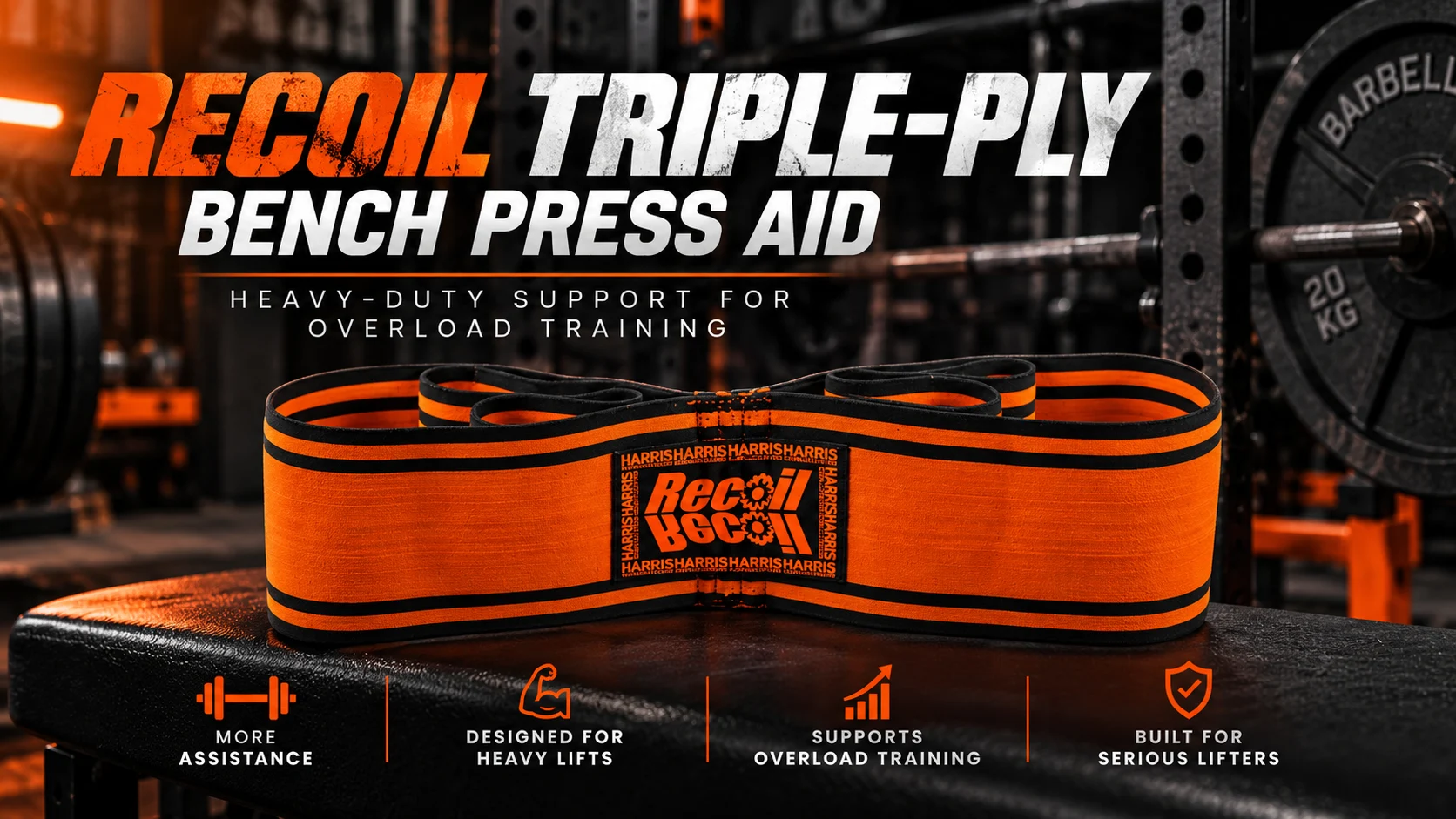
Recoil Triple-Ply Bench Press Aid: Heavy-Duty Support for Overload Training
A Bench Press Aid for Serious Strength Training
The Harris Recoil Triple-Ply Bench Press Aid is designed for strength athletes who want a high-resistance tool for assisted bench pressing and overload training.
Its reinforced triple-ply construction provides more assistance and resistance than lighter bench press aids, making it better suited to experienced lifters working with demanding loads.
Used correctly, the Recoil can help lifters introduce heavier weights, practise handling loads above their normal raw working range and add specialised pressing work to an established bench program.
It should be treated as a training tool rather than a replacement for raw bench press technique.
What Is a Bench Press Aid?
A bench press aid is a wearable resistance device positioned around the arms during pressing exercises.
As the lifter lowers the bar, the material stretches and stores tension. That tension then provides assistance as the bar begins moving upwards.
The amount of assistance depends on several factors, including:
• The construction of the device.
• The number and stiffness of its layers.
• Correct sizing.
• How deeply the bar is lowered.
• The weight being lifted.
• The lifter’s arm and bench position.
A triple-ply model generally provides a stronger and more rigid feel than a single-ply or double-ply alternative.
What Does Triple-Ply Mean?
“Triple-ply” refers to the product’s reinforced three-layer construction.
Compared with lighter versions, triple-ply construction is intended to provide greater resistance as the bar is lowered and more assistance during the upward phase of the press.
That makes it best suited to lifters who already have experience with:
• Consistent bench press technique.
• Heavy barbell training.
• Assisted bench press tools.
• Controlled overload work.
• Appropriate spotting and safety procedures.
A triple-ply aid may feel overly demanding for beginners or lifters who are still learning basic bench press mechanics.
Key Features of the Recoil Triple-Ply Bench Press Aid
Reinforced Triple-Ply Construction
The multi-layer design provides a firm resistance profile during the lowering phase of the bench press.
This stronger construction is intended for advanced training applications rather than light general assistance.
Designed for Overload Training
The Recoil can be incorporated into sessions where the goal is to handle weights above a lifter’s normal raw working range.
Overload work may be used to practise:
• Unracking heavier loads.
• Maintaining a controlled setup under increased weight.
• Pressing through the upper portion of the movement.
• Becoming familiar with heavier bar loads.
Any increase in training weight should remain planned and controlled.
Repeatable Pressing Assistance
When worn and positioned consistently, the aid can provide a repeatable level of assistance across working sets.
Correct fit remains important because a device that is too loose, too tight or incorrectly positioned may behave differently from one session to the next.
Portable Training Tool
Unlike specialised bench shirts or larger pieces of strength equipment, a bench press aid is relatively compact and easy to carry in a gym bag.
This makes it practical for lifters who train at different facilities.
Who Is the Triple-Ply Recoil Best For?
The Recoil Triple-Ply Bench Press Aid is most appropriate for:
• Experienced powerlifters.
• Strength athletes with an established bench press technique.
• Lifters conducting planned overload work.
• Athletes wanting assistance through part of the press.
• Bench specialists working on heavier lockout training.
• Lifters who have already used lighter bench press aids.
It may not be the best starting point for:
• Complete beginners.
• Lifters who cannot yet maintain a consistent bar path.
• Athletes training without suitable safeties or spotters.
• Anyone returning from pain or injury without professional guidance.
• Lifters looking for a substitute for raw bench training.
What Is Overload Bench Press Training?
Overload training involves performing a movement with more resistance than the athlete would normally use under standard conditions.
During the bench press, this may involve tools such as:
• Bench press aids.
• Boards or blocks.
• Resistance bands.
• Chains.
• Partial-range pressing variations.
The purpose is not simply to load as much weight as possible.
A well-planned overload session should have a specific objective, such as becoming familiar with heavier loads, developing the upper portion of the press or adding targeted competition preparation.
Overload work should generally complement raw bench pressing rather than replace it.
Triple-Ply vs Lighter Bench Press Aids
The right construction depends on the lifter’s experience and the purpose of th e session.
|
Feature |
||
|---|---|---|
|
Resistance during descent |
Lower |
Higher |
|
Assistance during press |
Moderate |
Greater |
|
Ease of learning |
More accessible |
More demanding |
|
Typical user |
Beginner to intermediate |
Experienced lifter |
|
Training application |
Technique, volume and moderate overload |
Heavier overload work |
|
Raw carryover |
Depends on programming |
Depends on programming |
More assistance is not automatically better.
A stronger device may allow heavier loads, but it also requires greater experience, control and programming discipline.
How to Use the Recoil Triple-Ply Aid
Begin Below Your Maximum
Do not immediately load the bar with weights above your raw maximum.
Start with a manageable load and learn how the device changes the descent and pressing motion.
Position It Correctly
Follow the product instructions for correct placement around the arms.
Both sides should sit evenly so the aid applies tension consistently.
Maintain Your Normal Setup
Continue using your standard bench press fundamentals:
• Stable foot position.
• Consistent upper-back setup.
• Controlled unrack.
• Predictable touch point.
• Controlled bar descent.
• Active pressing intent.
Do not rely on the product to correct an unstable setup.
Lower the Bar Under Control
The stronger resistance of a triple-ply device can change how the bar feels during the descent.
Avoid forcing the bar quickly towards the chest simply to stretch the material.
Use Appropriate Spotters or Safeties
Assisted overload work can involve heavier-than-normal loads.
Use experienced spotters, correctly positioned safety arms or both.
Keep the Volume Sensible
Overload pressing can be demanding.
Introduce it gradually and avoid adding excessive volume simply because the aid allows more weight to be placed on the bar.
How to Choose the Correct Size
Sizing can significantly affect the amount of resistance and assistance provided.
A fit that is too loose may not generate the intended tension. A fit that is excessively tight may be difficult to position and uncomfortable to use.
Before ordering:
1. Follow the Harris product-specific measuring instructions.
2. Measure the required arm or body area accurately.
3. Compare your measurement with the current sizing chart.
4. Do not select a smaller size simply to create more assistance.
5. Contact Harris if your measurement sits between sizes.
Use the sizing method stated on the actual product page rather than relying on general clothing size.
When to Include It in Your Program
A triple-ply bench press aid may be included during:
• Bench press overload sessions.
• Competition preparation.
• Lockout-focused training blocks.
• Heavy secondary bench sessions.
• Planned exposure to weights above normal raw working loads.
It does not need to be used during every bench session.
Many lifters will obtain better balance by combining:
• Raw competition-style bench pressing.
• Moderate-volume assistance work.
• Upper-body accessory exercises.
• Periodic overload training.
The appropriate balance depends on the athlete, their goals and their coach’s programming.
Common Mistakes to Avoid
Loading Too Much Weight Too Soon
Assistance from the device does not remove the need to control the load.
Learn how the aid behaves before attempting heavier overload sets.
Changing Your Technique to Fight the Device
The product should complement a controlled bench press setup.
If the bar is being pulled into an unfamiliar or unstable path, stop and reassess the fit, placement and load.
Using It Without Spotters or Safeties
Overload work should not be performed in an unsafe rack setup.
Replacing Raw Bench Training
Heavy assisted repetitions are not identical to raw bench pressing.
Continue practising the movement required for your training or competition goals.
Choosing an Incorrect Size
An incorrectly sized aid may provide inconsistent assistance or be difficult to use properly.
Caring for the Recoil Triple-Ply Bench Press Aid
To help maintain the product:
• Allow it to air after training.
• Store it in a cool, dry location.
• Avoid leaving it in a damp gym bag.
• Inspect the material and stitching regularly.
• Keep it away from sharp surfaces.
• Follow the product-specific washing instructions.
• Do not use it if the material or seams appear damaged.
Repeated stretching places stress on the construction, so regular inspection is particularly important.
Frequently Asked Questions
Does a bench press aid increase how much I can bench?
It can provide assistance during the press, which may allow some lifters to handle more weight than they can bench raw. The amount varies according to the product, fit, technique and individual lifter.
Is the triple-ply Recoil suitable for beginners?
It is generally better suited to experienced lifters. Newer athletes may benefit more from developing consistent raw technique or beginning with a less resistant model.
Will it improve my raw bench press?
It can be used as part of a broader bench press program, but raw improvement is not guaranteed. Results depend on programming, technique, recovery and how the tool is used.
Can I use it for exercises other than bench press?
Some bench press aids may also be used for pressing variations, but only use the Recoil for movements recommended by Harris in the product instructions.
Should I use it for every bench session?
Usually not. It is better treated as a specialised training tool alongside regular raw bench pressing.
Do I still need a spotter?
Yes. Appropriate spotters or rack safeties remain essential, particularly when using overload weights.
Why Choose the Harris Recoil Triple-Ply Bench Press Aid?
The Recoil Triple-Ply Bench Press Aid is intended for lifters who want a high-resistance option for advanced pressing sessions.
Its key characteristics include:
• Reinforced triple-ply construction.
• Strong resistance during the descent.
• Assistance during the pressing phase.
• Suitability for planned overload training.
• A compact design for gym use.
It is a specialised product for lifters who understand why and when assisted bench pressing belongs in their program.
Final Thoughts
The Harris Recoil Triple-Ply Bench Press Aid is designed for experienced strength athletes conducting controlled overload work.
Its reinforced construction provides a more demanding feel than lighter bench press aids, making it suitable for heavier assisted bench sessions, lockout-focused work and competition preparation.
It should not be viewed as a shortcut to a stronger bench press or a substitute for sound technique.
Used with appropriate programming, correct sizing and suitable safety equipment, it can provide an additional training option for lifters who already have strong bench press fundamentals.