Why Harris Liquid Chalk Is Essential for Grip, Strength, and Training Confidence
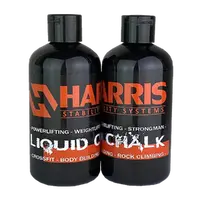

Athletes from any discipline require a grip that is both consistent and under their control if they want to perform at their best. The question of whether one is lifting heavy weights, climbing or training through functional movements, a stable grip can both affect safety as well as the results. Many athletes use Harris Liquid Chalk simply because it is cleaner and lasts longer than the traditional powdered chalk, which is their main concern. In a high, intensity workout, the performance is limited by the sweat on the palms and the risk is increased unnecessarily.
Liquid chalk alleviates this issue by providing quick, drying adhesion as well as support that remains consistent during the entire session. The use of liquid gym chalk is becoming very popular because of its portability and the fact that it makes less mess. The fitness centers, which have very strict policies on the use of chalk, usually give their approval to liquid versions because they minimize dust and keep the equipment cleaner. As the expectations of performances rise, the number of athletes who are looking for grip enhancers that will help them achieve their training goals without any interruptions is also increasing.
The lifting chalk that is reliable is the one that gives the users the confidence that they need when they are approaching heavier loads or technical movements, thus enabling them to be able to use the correct form. This write, up first of all touches upon the basics of liquid chalk, the remarkable benefits of Harris Liquid Chalk, performance concepts at a deeper level, traditional options to compare with, as well as practical tips for making a choice. These are insights that guide athletes looking for grip support that is dependable and can be used in different training environments.
What Makes Liquid Chalk an Essential Training Tool?
Liquid chalk has revolutionized the way athletes stay grippy during hard workouts. A good example is the Harris Liquid Chalk product that users can purchase for better and efficient application. Unlike powder chalk that scatters and dissapears quickly, liquid chalk dries into a thin and tough layer on the skin that is very resistant to sweat and rubbing. Weightlifting, rock climbing, gymnastics, and crossfit are activities that can be performed with liquid chalk. Users of such a product enjoy its controlled application and less waste.
Liquid gym chalk is used in small amounts and it is dry fast, thus creating a solid grip surface. The advantage is very clear in situations such as humid environments or intense workouts where hand moisture can build up quickly. Since the formula bonds evenly to the skin of the hands, athletes have very little slipping and more stability during lifts.
Liquid Chalk vs. Powder Chalk
|
Feature |
Liquid Chalk |
Powder Chalk |
|
Mess Level |
Very low |
High |
|
Longevity |
Longer-lasting friction |
Shorter grip duration |
|
Application Control |
High |
Moderate |
|
Gym-Friendly |
Widely accepted |
Often restricted |
As gyms implement more strict cleaning measures, liquid chalk continues to be one of the most recommended options. The main reason for its success is the fact that it can provide a firm grip with almost no residue, thus being the favored choice of top, level athletes.
Key Performance Benefits of Harris Liquid Chalk
Consistency, drying time, and friction performance are the most important factors for high quality chalk products. Harris Liquid Chalk is best known for its feature of strong adhesion and smooth application. It has been formulated to facilitate all kinds of lifting styles ranging from powerlifting to functional training.
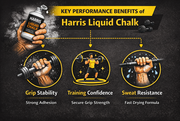
Grip Stability, Training Confidence & Sweat Resistance
Grip stability is essential to both an athlete's performance and their safety. In the case of sweaty hands, the risk of losing control in the middle of a lift Accessory or a movement is very high. Harris Liquid Chalk creates a dependable layer that keeps friction even when the training set is long. The athlete thus gains the stability that allows them to concentrate on their form and not on the fact that their grip is failing.
When grip is no longer an issue, the confidence with which the training is approached also increases. Athletes are more inclined to go for heavy lifts or repeat challenging movements when they feel secure. A firm grip diminishes hesitation and thus execution is at a higher level. This advantage is particularly great in exercises such as deadlifts, pull, ups, kettlebell swings, or rope climbs.
Resistance to sweat is an attribute that guarantees the good performance of the product even during intense sessions of high volume. Liquid chalk keeps the grip more efficient for a longer time than powdered versions. Consequently, many athletes choose it for their conditioning workouts where they are constantly on the move and thus it is inconvenient to keep reapplying the product.
Moreover, the formula is fast, drying and it leaves very little residue. This contributes to the cleanliness of the equipment, something that is very important in a gym that is shared by many. The trio of stability, confidence, and sweat resistance is what makes the training experience go smoothly.
Performing athletes who require equipment that can deliver under pressure settle for Harris Liquid Chalk as a solution to their problems of control, slipping/falling off, and poor consistency across their workouts.
Comparing Grip Performance: Liquid Chalk vs. Other Grip Solutions
Athletes use different methods to improve their grip, like gloves or powdered chalk and liquid products. However, each of these solutions only has unique features. Gloves protect the hand but can lessen the touch sensitivity. Powdered chalk is fast in improving friction but also creates dust.
Liquid chalk is a clean and a more durable solution with no sacrifice of the hand's feel. Among these options, liquid chalk is usually the best performer of the most balanced criteria. It allows heavy lifting, climbing, and high, rep movements. So, with such a product as Harris Liquid Chalk, users enjoy the same level of friction for the whole workout session.
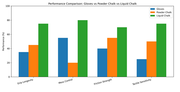
Grip Enhancement Comparison
- Liquid chalk offers the best overall performance by a wide margin, particularly in terms of grip longevity and tactile sensitivity.
- Powder chalk gives off reasonable friction but its mess control is so bad that it is not a very gym, friendly product.
- Gloves can help to a certain extent with mess control but they also reduce tactile sensitivity and grip precision.
- Even after a long period of time, liquid chalk is able to deliver the same level of friction and so it is a clear winner over both gloves and powder chalk.
- In situations where the air is controlled and clean, liquid chalk is the most balanced alternative.
Examples from the world of athletic training validate the advantages of liquid chalk. It is a must, have for weightlifters, especially during deadlifts and pull, ups. Climbers use it as a shield against the moisture caused by sweat. Gymnasts find it in a pleasure, as it is smooth and consistent. The reason liquid chalk can be a companion for any kind of training is because it is not only handy but also durable.
Practical Tips for Choosing and Using Liquid Chalk Effectively
Choosing an effective liquid chalk leads to an improved grip and a training session that feels comfortable throughout. Athletes are advised to make use of a quick, drying product that is nearly odorless and allows for easy application. Moreover, the lifting chalk ought to be of such a quality that it can be evenly spread without forming lumps.
- Choose fast-drying formulas to maintain training flow.
- Select products with smooth, non-sticky finishes.
- Look for long-lasting performance suited for high-intensity sessions.
- Ensure portability and leak-resistant packaging.
Application method can also impact the effectiveness of a grip. A user ought to take a small amount at first, and then evenly distribute the substance between their palms and fingers. The product should be left to dry to the maximum friction possible.
It may be necessary to apply it anew if you have had a very long session, but it will be much less often than with powder chalk. Athletes exercising in shared gyms should also concern themselves with hygiene. Liquid chalk greatly reduces the amount of residue and thus makes bars and equipment cleaner.
This cleans the training environment and pleases the users. When athletes opt for such dependable solutions as Harris Liquid Chalk, they get a stable grip, safety, and training confidence at a higher level. The right formulation will allow you to perform your workouts durably and with better results.
Why Harris Liquid Chalk Remains a Top Choice
Grip strength is a major factor that influences performance in sports as well as various training styles. One of the reasons that liquid chalk is has become a preferred option is that it offers durability, cleanliness, and consistent friction. Generally, athletes in need of reliable grip support mostly select Harris Stability systems Liquid Chalk because they feel its smooth application and long, lasting performance. In the first place, unlike powdered chalk, liquid versions are still effective in high, humidity environments.
They give a chance for athletes to have control during heavy lifts, repetitive movements, and challenging climbs. As a result, slipping is reduced and thus safety is improved. Selecting the correct liquid chalk means going through criteria like drying time, consistency, and longevity.
When athletes make a decision to spend their money on a high, quality formula, they yield better results and experience greater training confidence. The present, day training atmospheres call for grip solutions that can perform excellently under pressure. Through balanced friction, clean application, and reliable resistance to sweat, Harris Liquid Chalk is at the level of satisfying these requirements. As a result, reliable grip enhancement is going to be the most important thing as athletes continue to break the limits of their performance. To keep control, improve technique and be supported in long, term training, liquid chalk is still one of the most efficient devices.